Search is changing. For years, companies have been paying attention to improving their presence on Google by optimizing their sites for people looking to buy their products or services, and to capture organic traffic. Although SEO still remains important, there are other ways people are able to find information on the web.
AI search experiences can provide users with direct, summarised answers, rather than just list down websites. This change has led to the emergence of a new strategy called Generative Engine Optimization (GEO), which focuses on improving visibility in AI-generated answers.
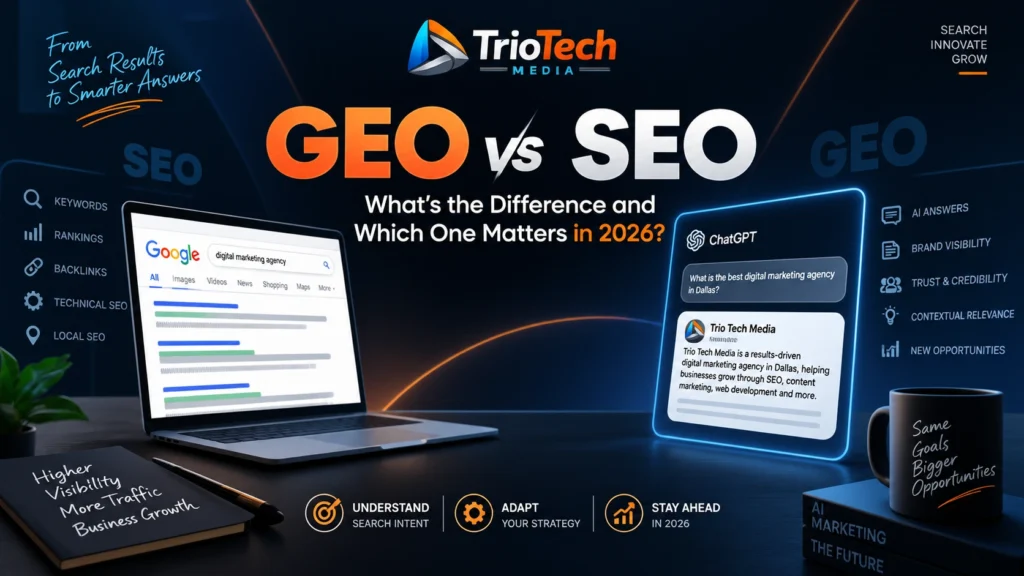
Thus, what’s the difference between GEO and SEO? SEO is all about optimizing content for visibility in traditional search results, and GEO is all about optimizing a brand or its content for ease of discovery, ease of understanding and ease of referencing in outcomes generated by AI. They provide a different search experience but that doesn’t mean that businesses would need to pick and choose. SEO can be applied in conjunction with GEO.
What Is SEO?
Search Engine Optimization (SEO) improves the visibility of a website in the organic search results. Search engines attempt to give useful and helpful results when people look for information, products or services.
The goal of SEO is to enable search engines to comprehend your website and its material. It also emphasizes the user experience of those that visit your pages. The effective SEO strategy typically features helpful content, technical optimizations, relevant keywords, internal links, backlinks, and a clear website structure.
What Are the Main Elements of SEO?
SEO is a lot more than stuffing keywords into a page. It has some of the most important features, such as:
- Keyword research: Understanding what your audience searches for.
- On-page SEO: Optimizing content, headings, titles, internal links, and page structure.
- Technical SEO: Making your website crawlable, indexable, fast, and accessible.
- Content: Creating important pages that satisfy search intent.
- Off-page SEO: Building authority through relevant backlinks and brand mentions.
- Local SEO: Improving visibility for searches related to a specific geographic area.
Research is particularly crucial when developing content. Best Keyword Research Tools can guide businesses to discover search terms that align with their target audience’s interests, assess their relevance, identify competition, and create content that resonates with their audience’s search intent.
What Is GEO?
The GEO is a key term in web optimization; it’s short for Generative Engine Optimization. It’s a strategy for increasing a brand’s and its content’s visibility in AI-driven and generative search.
With regular search, users may receive a few different results and can choose which site to visit. Generative search, on the other hand, can produce a direct answer, aggregating information for the user’s inquiry. This is the reason why a business can become visible while a user is conducting research, but not necessarily click through to the business’ website.
Thus, GEO pays a lot of attention to the clarity, usefulness, trustworthiness and understandability of information. Businesses should also take into account what questions are being asked, the context of the questions, and whether content can answer them.In addition to writing around keywords, businesses should also be mindful of the questions that people are asking and the context behind the questions, and whether the content can provide an answer.
What Makes Content GEO-Friendly?
To get a page to “show up” in an AI-generated answer, there is no ‘formula’ involved. Content is more likely to be well suited for AI discovery if it offers clear answers, addresses the content, has logical headings, offers useful context, and backs up key factual claims with reliable information.
GEO shouldn’t be about writing for machines, not people. The aim remains to assist the reader. The twist here is the information needs to be structured well enough to be understood in the various search contexts.
GEO vs SEO: What’s the Difference?
The difference between GEO vs SEO is the focus on where they are attempting to create visibility. The SEOs typically target the organic search results, and the GEOs typically target the visibility in AI-generated results.
Here is a simple comparison:
| Factor | SEO | GEO |
| Main Goal | Improve organic search visibility | Improve visibility in AI-generated answers |
| Primary Focus | Traditional search engines | AI-powered and generative search |
| Content Approach | Keywords, relevance and search intent | Questions, context and direct answers |
| User Experience | User clicks a search result | User may receive a generated answer |
| Authority | Content quality, links and trust | Credibility, context, mentions and authority |
| Main KPIs | Rankings, traffic, clicks and conversions | AI mentions, citations, referrals and conversions |
What’s important to realize is that there is much overlap between SEO and GEO. Both have original content, structure, relevance, authority and user intent. GEO is not eliminating the need for these classic SEO strategies.
SEO vs GEO vs AEO: How Are They Different?
SEO, GEO, and AEO are frequently spoken of as a unit, since they are all linked to visibility in search engines. But what they’re interested in is a bit different.
SEO: Search Engine Optimization
SEO is all about improving the visibility of the content in the normal organic search results. Its aim is typically to improve the ranking of related pages in search results for search queries that are important to a business and that can generate qualified traffic.
AEO: Answer Engine Optimization
AEO stands for Answer Engine Optimization. It is based on providing a clear and concise answer to a specific question. An AEO-friendly page should supply an answer to an inquiry quickly, say “What is local SEO?” for example, without the user having to sift through several paragraphs.
GEO: Generative Engine Optimization
GEO focuses more specifically on generative search experiences. It is designed to improve the clarity, credibility, and relevance of information and brands in AI-generated responses.
In actual fact, the three methods may be used in conjunction. A useful article can be designed to address relevant search demand for SEO, common questions with clear answers for AEO and well structured, credible information that supports GEO.
How Can Businesses Optimize for SEO and GEO Together?
You don’t need to develop an AI search version of your website and a different version for Google. A lot of enhancements can assist both. The first place to start is to create authentic helpful content based on what your audience needs.
1. Understand Search Intent
Before creating content, understand why someone is searching for a particular topic. They may be looking for basic information, comparing different solutions, researching a company, or preparing to purchase a service. Matching your content with the user’s search intent makes it more useful and helps you avoid including information that does not answer their actual query.
2. Answer Important Questions Directly
For sections that include “What is GEO?”, begin the introduction for that section with the explanation of GEO. Avoid a lengthy introduction before you get to the answer. After you’ve given the reader the answer, you can add supporting details and examples to make the answer clearer.
This will make content more readable and also help to establish clear sections to answer specific questions.
3. Build Topical Authority
Work on a series of articles rather than publishing “canned” articles. An SEO website, for instance, could feature tutorials on keyword research, local SEO, technical SEO, link building, AI search and content optimization.
These topics can then be naturally linked by internal links. If a business is able to reach customers in a competitive market, they may consider professional SEO services Dallas to learn about the importance of location-based SEO and how it can boost organic visibility.
Likewise, a comprehensive Local SEO for Small Business guide can help business owners better understand various aspects of local search optimization, including local search visibility, optimizing Google Business Profile, and understanding local search intent.
4. Make Content Easy to Understand
Simple language is good enough to show expertise. Ensure that very clear headings, straightforward explanations, examples, tables and bullet points are used where they significantly improve understanding.
Don’t add paragraphs for the sake of word count. Each section should answer a question, explain an idea, or aid in a decision.
5. Strengthen Credibility
In both SEO and GEO, it’s all about trust. The factual claims should be correct and if statistics or research are used, it should be backed up by reliable sources. Important pages should also be kept current and not left to the old information to hang around.
Constructing authority over a topic will take time. Focusing on consistent quality and valuable content, gaining links and mentions based on topic relevance and clearly showing expertise can aid in increasing a brand’s search visibility.
What KPIs Should You Track for GEO vs SEO?
SEO is a well researched performance marketing discipline. Popular metrics for businesses include keyword rankings, organic impressions, clicks, website traffic, backlinks, leads, and conversions. These metrics can help to determine if a site is getting any search visibility or whether that visibility is driving real business outcomes.
Important SEO KPIs
Some useful SEO metrics include:
- Organic rankings
- Search impressions
- Organic clicks
- Click-through rate
- Organic traffic
- Leads and conversions
- Backlinks and referring domains
Important GEO KPIs
GEO measurement is still developing, so businesses may need to look beyond traditional traffic metrics. Useful indicators can include:
- Brand mentions in relevant AI-generated answers
- Citations or references to website content
- Referral traffic from AI platforms
- Visibility for important industry questions
- Branded search growth
- Leads or conversions influenced by AI discovery
This is significant because not every time someone uses AI visibility means that they are visiting the website. A user can find a brand based on an AI response and look up the brand afterwards.
For a digital marketing agency like TRIO Tech Media, that translates to the ability to increasingly measure both the traditional ways that brands can appear in search results, and the consistency with which they can be found in newer AI-powered search experiences.
Does GEO Replace Traditional SEO?
No, GEO does not replace SEO. However, traditional search remains a vital tool when it comes to finding a business, comparing services, researching products and visiting a website. GEO is just another space businesses need to take into account as search behavior evolves.
There is also a very close relationship between the two. Content can be more accessible to AI systems and traditional SEO can be complemented with useful content, clear site structure, technical accessibility, internal linking, topical authority, and credible information.
Rather than replace SEO with GEO, companies need to adapt to their current search strategy. The foundation is strong SEO and the next generation of information discovery is answered through GEO.
Which Is Better: GEO or SEO?
SEO vs GEO is not a straightforward battle as both search visibility types are different. SEO can drive rankings, clicks, organic traffic, and conversions to a website. When individuals use AI-driven systems to conduct topic or question research, GEO can play a role in helping a brand gain visibility.
The best way for most businesses is to use both. Focus on content that is easier to understand, more authoritative, and more useful to AI for discovery, as well as continuing to invest in the SEO basics that have proven to work.
The goal should be neither to optimize for an algorithm only. It should be to be a useful and trusted source of information in all places where your audience is looking.
Frequently Asked Questions About GEO vs SEO
What is the main difference between GEO and SEO?
SEO works to improve websites’ visibility in traditional search results, whereas GEO works to improve the visibility of the brand and content in AI-generated responses.
Is GEO better than SEO?
There isn’t one of them that’s automatically superior. GEO is an add-on to SEO, which is still relevant for organic rankings and traffic, and generative search offers further visibility opportunities. The two can be integrated into a business for profit.
Does GEO replace SEO?
No. GEO does not replace SEO. Many SEO fundamentals, including useful content, authority, technical accessibility, internal linking, and relevance, can also provide a strong foundation for GEO.
What are the KPIs for GEO vs SEO?
The KPIs for SEO include rankings, impressions, organic clicks, traffic, backlinks, leads and conversions. GEO can also include monitoring for AI mentions, citations, AI referral traffic, branded search, and AI discovery-driven conversions.
Is AEO the Same as GEO?
While GEO is more broadly oriented towards visibility in generative AI responses, No. AEO concentrates on giving answers to users’ questions directly. There is, however, a lot of overlap in the two methods.
How Can You Optimize Content for GEO?
Provide informative and factual information, directly address questions, use descriptive headings, address topics appropriately, use reliable sources to support claims, build topical authority, and maintain current important information.
Final Thoughts
It’s not so much a choice between GEO and SEO. It’s a sign of the changing way in which people find information on the internet. SEO remains crucial for websites to find visibility in the traditional search results while GEO opens the door for brands to be visible in the AI search results.
The best way is to learn and work with the core principles of SEO while adapting to the evolving search landscape. Provide valuable information, provide answers, establish authority for the topics, and make your content accessible. Firms that consistently execute such tasks will be equipped better to secure visibility, through traditional search or AI platforms.